

Why control room effectiveness is a structural question.
Control rooms serve as the operational nerve centres of organisations across security, transport, utilities, emergency services, and critical infrastructure. They exist for one purpose: to manage risk and make consequential decisions, at pace, under pressure, often with incomplete information.
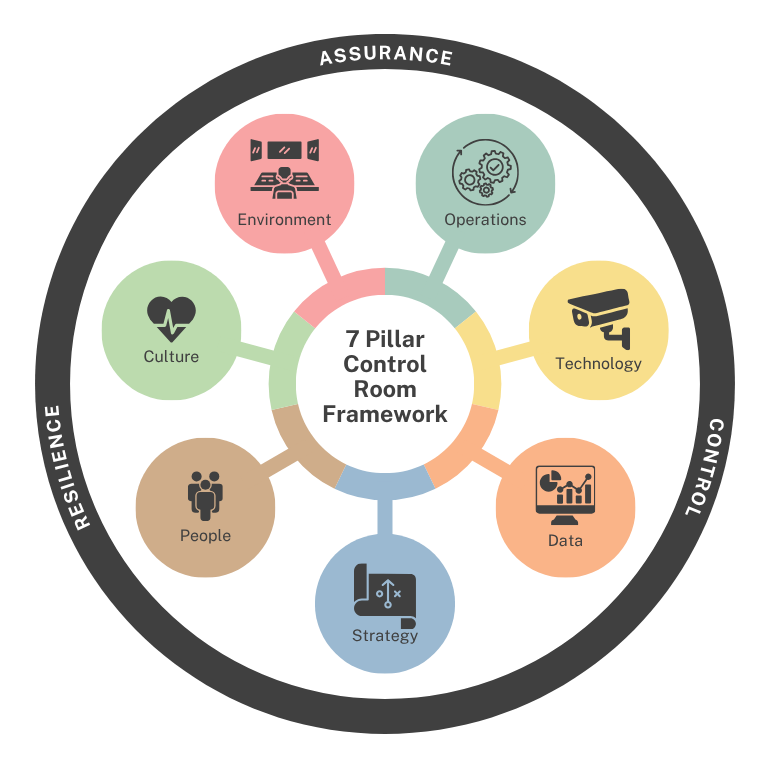
When control rooms underperform or fail outright, the cause is rarely what it first appears to be. In the vast majority of cases, failure is structural. The system that was supposed to support good decision-making was not mature enough to do so when it mattered most. The 7 Pillar Control Room Framework was developed to address this. It defines what structural maturity actually means in a mission-critical control room.
The framework is not a checklist. It is a governance-led maturity model that gives executive leaders a clear, defensible way to understand where their operation is structurally exposed – and what to do about it.

The framework assesses control room maturity across seven structural pillars:
Strategy | People | Culture | Environment | Operations | Technology | Data
1. Strategy – Purpose, outcomes, and executive intent. Strategy is the most commonly missing pillar in control room design. Many control rooms operate without a clearly articulated strategic purpose, conflicting priorities across stakeholders, and ambiguity over what must be protected at all costs. Mature control rooms have explicit executive ownership of what the control room exists to deliver, defined tolerances for delay, escalation, and failure, and clear operational outcomes linked to organisational risk.
2. People – Recruitment, capability development, and retention. Control rooms are only as strong as the people within them. Immature organisations treat recruitment as a job-filling exercise and training as a compliance requirement. Mature ones invest in structured recruitment processes that select for the behaviours and thinking patterns that determine performance under pressure, and retention strategies that protect hard-won experience. Experienced operators are not interchangeable – the judgement built through hundreds of real incidents is not replaceable quickly.
3. Culture – Behaviour, accountability, and learning when things go wrong. Culture in a control room is not what is written in the values statement. It is what actually happens when something goes wrong. In immature control room cultures, blame follows failure and risk is hidden rather than surfaced. Mature control room cultures are built around psychological safety: operators can challenge decisions, raise concerns, and admit errors without fear of consequences. Near-misses are treated as intelligence, not embarrassments.
4. Environment – Physical and digital design that enables judgement, not overload. The physical and digital environment directly shapes how decisions are made. This is decision infrastructure. An environment that overwhelms operators with noise, competing alerts, and poorly configured screens actively degrades judgement at precisely the moments when judgement is most consequential. Mature environments are designed around the decision cycle, with ergonomics, alert configuration, screen layout, acoustics, and physical positioning all considered as components of a single operational system.
5. Operations – Decision-making under pressure, escalation frameworks, and workflows. Operations is where all seven pillars are tested in real time. Without clear operational structure, control rooms default to reactive firefighting. Different supervisors handle the same incident type differently. Escalation happens informally, inconsistently, and often too late. Mature operational control is built on structured decision-making authority, clear escalation triggers, defined decision rights, and practised responses that do not require improvisation under pressure.
6. Technology – Tools selected to support decisions, not distract from them. Technology is the pillar that receives the most investment and, in many organisations, the least critical scrutiny. Systems are procured, platforms are integrated, and dashboards multiply, but the fundamental question is rarely asked: does this technology improve the quality and pace of decisions, or does it add to the cognitive load operators are already carrying? Technology should be selected and configured to support a clearly defined operational model, not the other way around.
7. Data – Information discipline that reduces uncertainty and drives action. Data does not create clarity by default. In many control rooms, the problem is not a shortage of data. Multiple systems generate overlapping streams of information, alert volumes exceed the capacity to triage them meaningfully, and operators are left to make consequential decisions based on a partial and often contradictory picture. Mature control rooms apply discipline to information. That discipline has three components: knowing what information matters and what is noise; knowing when information can be trusted; and ensuring that information reaches the people who need to act on it in a format that supports rapid judgement.
From framework to action.
The 7 Pillar Control Room Framework answers the questions that matter most: where is the operation structurally exposed? What would fail first under pressure? Is performance dependent on a mature system or on the knowledge and judgement of specific individuals? The framework is the foundation of the Control Room Maturity Audit – a structured, evidence-based assessment that evaluates your operation against all seven pillars and produces a clear maturity score, a structural risk profile, and a prioritised improvement roadmap.
Comments are closed